Alright so I'm already off to bad start with meeting my goal of posting a daily update, but so far I'm still within the weekly goal.
There really wasn't much to say about yesterday, so I didn't feel compelled to write anything. I will have to be mindful of what I say in this post because I'm not sure who all will read it. So, this week is primarily focused on "training," planning, and set up. As mentioned in a previous blog post, I am currently in a pediatrics and mental health fieldwork.
If I can be completely honest my experience with the pediatric fieldwork has not been that enjoyable. So far it seems unorganized and incomplete meaning that essential details seem to be missing. I have been confused since day 1 and that confusion has not subsided much since then either. We are told what we are supposed to do, but not exactly how we are supposed to do it and sometimes not even when. On the first day, it was emphasized what things could cause you to fail fieldwork. There were many things mentioned and much of them were mistakes that could easily be made. Therefore, when things are unclear I find that I get really frustrated in fear that I will miss something and fail fieldwork. In my younger days, I was more of a "go with the flow" person, but since I have gotten older...not so much. I'm trying to work on it, but so far, no good.
Continuing on with pediatrics, when I heard "training" I thought we were actually going to be trained on the skills necessary to successfully plan and implement activities/interventions for these summer programs. However, so far, that has not been the case and today was really our last day of training. We went over the syllabus, our general role in the summer program, and discussed TEAMSTEPPS which is an evidenced-based model designed to optimize team performance.
Today was little bit more exciting, we did much more activities and such. Since we are working interprofessionally with speech language pathology (SLP) students we did an activity where we had 5 minutes to write on a large piece of poster paper what we thought the other profession did (e.g., SLP wrote what they thought OT did, and OT wrote what they thought SLP did). Then we did a campfire activity where one student acted as the "client" and sat on a wiggle seat cushion or an exercise ball and had to follow the woman in the front's directions using pretzels, hot tamales, and marshmallows. After the activity, we had to label the SLP components (e.g., receptive language, articulation, sensory components, protesting) and OT components (e,g., balance, posture, stability, attention, problem solving, fine motor skills) of the activity. Then a lady came and talked to us about behavior regulation and some of the activities we will be doing with the students. After that, we were broken into our programs where we discussed a bit more about the specifics and then had to plan all 8 days of the program. We were split into about 4 people per day and were responsible for planning the activities and snacks for that day. The planning was a little rocky, but it went smoother than I anticipated so that was good.
Overall, today was a good day. The issues didn't come about until it was time to wrap up and it was announced that X, Y, Z was due and that shopping was going to be done Friday. However, outside of shopping, it was not clear (and it still not clear) how Friday is going to go with setting up and everything. Right now i'm just playing the waiting game and seeing if there will be a clarification email of some sort sent out. If not, I'll have to ask my classmates and see how they interpreted everything. I'm hoping that once the planning phase is over and we actually start the program everything will fall into place. **fingerscrossed**
In regards to the mental health fieldwork, it is much more organized and clear. I'm looking forward to my mental health fieldwork much more! We toured the inpatient psychiatric unit today. It's a small facility, but I look forward to sitting in on one of the group's next week!
I could say more, but I'll end this post here.
<3 Bemo

Wednesday, May 27, 2015

Sunday, May 24, 2015
Does the Prestige of an OT School Matter?
Hey guys,
So this blog post is in response to a video created by DobberOT and itsmyOT. The topic is about whether the prestige of an OT school matters when selecting your program. These two individuals had differing opinions about the matter and I would argue that my opinion slightly differs from both of theirs as well.
First, when questioning prestige, we must determine what we are really talking about. When we say prestige what does that really mean? Is prestige equivalent to a ranking? I would argue no. Although prestige and ranking may be correlated, a ranking does not give a complete picture of a school's prestigiousness. The rankings of OT schools that you see posted on usnews.com or graduate programs.com are based solely on peer assessment surveys meaning that people within the system are ranking the program on X-Y-Z factors (not some "big dog" at the top). We must keep in mind that there are a lot of factors that influence these rankings, some of which we are aware of, but many of which we are not. Do I think that these rankings say something about the programs? Yes, but I still think it creates an incomplete picture and many false perceptions.
My OT program is ranked somewhere in the middle (not highly ranked, not lowly ranked) according to usnews.com and is actually in the top 10 according to graduateprograms.com. Despite this inconsistency in rating, I would argue that my school is fairly prestigious. My program puts a strong emphasis on client-centered, evidenced-based practice. Therefore, a strong foundation in theory and research is paramount, however we also focus on practical applicability (which I know some "prestigious" schools often lack).
Another thing about my program is that the faculty are all "down to earth" and easily approachable, including the program director. Their doors are always open, they are very knowledge, and they do not hesitate to answer questions. As also mentioned by itsmyOT, my professors are not only professors but they are also active clinicians and researchers. Many of them present at both the state and national conference for occupational therapy each year.
Our program also has many great connections when it comes to guest speakers, off-campus observations and opportunities, and fieldwork sites. Our program is contracted with an abundance of fieldwork opportunities within the state (not just locally, but all throughout the state) and is also contracted with facilities in 20 other states. Also, because we have established such a good reputation through the performance of our fieldwork students, we are easily able to contract with new sites and keep strong relationships with the old.
Also, when talking about prestigiousness we have to consider outcomes. Outcomes include NBCOT first-time pass rate and clinician performance in real word settings. In 2013, we had a 100% first time pass rate. In 2014, we had a 97% first time pass rate (35/36) -- 100% by ACOTE's new standards. ACOTE standards have changed and now report pass rates as any new graduate who has passed the NBCOT exam during the testing year regardless of the number of attempts. I have also personally witnessed (even before deciding to apply to this school), the level of skill that both new grads and long-time clinicians that graduated from my program possess.
I could go on and on, but i'll just give one more example. A lady in itsmyot's comments mentioned that her OT program offers a course dedicated to assistive technology which apparently less than 5 schools in the US offer (that comment has since been edited). I don't know the accuracy of that statistic, but what I can say is that my program is one that offers an assistive technology course. If you read my last blog post "Summer Semester 2015: Fieldwork, Classes, Books," I mentioned that assistive technology was one of the courses I was taking this summer.
So what is my point? My point is that you cannot get too caught up with these online rankings and that you should not solely base your decision on a "ranking." You have to do your own research and really get down to the "nitty gritty" of what the program offers and how it can benefit you as a student and future clinician.
So what is most important? I would argue that accreditation and goodness of fit are the most important factors to consider when choosing a program. As I mentioned in my "Tips| Applying to an MOT program," you should be choosing a school that best fits your learning style, personality, and goals. If you don't, it doesn't matter how "prestigious" the school is, you will likely be unsuccessful or you won't reach your true potential as a future OT.
Well that's all I really have to say about the matter lol.
<3 Bemo
Tuesday, May 12, 2015
Summer Semester 2015: Fieldwork I, Classes, Books
Alrighty, so right now I'm on a short 2.5 week break. I finished classes on May 6th, headed home on May 7th, and am expected to return back to school by May 26th (the first day of the summer semester). On May 26th, the 2nd years (us) are hosting an MOT BBQ for the first years. I'm responsible for tracking RSVPs and tallying up the counts for hamburgers, hot dogs, and veggie burgers. If ya'll remember last years blog post "First Day: Orientation (Summer 2014)," I talked about going to the BBQ, meeting my "big", and leaving pretty shortly after. Last year, I really didn't socialize much, but this year I'm going to try to be a little more interactive.
Yesterday, I was assigned a "little." I really don't care for the "big/little" titles. It comes off very condescending to me, but whatever that's just me lol. Anyways, I got her information yesterday so I will be going to the store when I get back on the other end and buy her a gift, just like my "big" bought me one.
 Also, on May 26th, we will start classes and the first Fieldwork I rotations: Mental Health & Pediatrics.The two classes I will be taking are "Clinical Reasoning for Fieldwork" and "Assistive Technology."
My Mental Health rotation is at an inpatient psychiatric unit where we will be responsible for hosting therapeutic groups that provide just right challenges for the patients. There are three main types of groups: physical activity, psychoeducation, and therapeutic activities. We will be rotating between these 3 groups throughout the semester. The groups last about 45 minutes and usually contain 10-18 members. The groups will be held weekly for 7 weeks. We will be separated into groups of 3 I believe. I'm not sure who my partners are yet. Continuing on, the main diagnoses seen at this particular inpatient psychiatric facility are major depressive disorder, schizophrenia, schizoaffective, bipolar, and corresponding substance abuse or personality disorders. The other mental health rotation options were with a Program of All-Inclusive Care for the Elderly (PACE) and at a children's home, which while great options were not my top choices.
My Pediatric rotation involves working with students in grades Kindergarten through 5th on building social skills as well as language and literacy skills needed for children in elementary school. I will be in a group with 5 other individuals and we are working interprofessionally with Speech Language Pathology students. We will be responsible for planning themes and activities for 1-4 programs days, adding fine motor/sensorimotor components to activities, providing consultation in regards to fine motor, developmental, positioning, and other OT-related areas, and documenting sessions. The pediatric fieldwork only lasts about 1.5 - 2 weeks. The other pediatric rotation options include the same program, but with ages 3-6 years old, a handwriting camp, and a program designed to work with children with food selectivity.
Now that that is all out of the way, let's take a look at the required books. If you read my last blog post these books should look familiar! We will also be using a previously purchased book called "Occupational Therapy in Mental Health: A Vision for Participation." The "Assitive Technologies" book you see on the right is actually the 3rd edition. A month after sending out the original book list, the professor recommended that we instead purchase the 4th edition. I will just be asking a classmate of mine to look at there's if necessary. Too much time has passed to try and hassle with getting a refund and the 4th edition is around $100.
This is not set in stone, but my plan is to post AT LEAST a weekly blog post keeping you updated with my fieldwork experience! A daily update would be optimal, but I don't know if I can commit to that! lol
Well I will talk to y'all next blog post!
<3 Bemo
Yesterday, I was assigned a "little." I really don't care for the "big/little" titles. It comes off very condescending to me, but whatever that's just me lol. Anyways, I got her information yesterday so I will be going to the store when I get back on the other end and buy her a gift, just like my "big" bought me one.
 Also, on May 26th, we will start classes and the first Fieldwork I rotations: Mental Health & Pediatrics.The two classes I will be taking are "Clinical Reasoning for Fieldwork" and "Assistive Technology."
My Mental Health rotation is at an inpatient psychiatric unit where we will be responsible for hosting therapeutic groups that provide just right challenges for the patients. There are three main types of groups: physical activity, psychoeducation, and therapeutic activities. We will be rotating between these 3 groups throughout the semester. The groups last about 45 minutes and usually contain 10-18 members. The groups will be held weekly for 7 weeks. We will be separated into groups of 3 I believe. I'm not sure who my partners are yet. Continuing on, the main diagnoses seen at this particular inpatient psychiatric facility are major depressive disorder, schizophrenia, schizoaffective, bipolar, and corresponding substance abuse or personality disorders. The other mental health rotation options were with a Program of All-Inclusive Care for the Elderly (PACE) and at a children's home, which while great options were not my top choices.
My Pediatric rotation involves working with students in grades Kindergarten through 5th on building social skills as well as language and literacy skills needed for children in elementary school. I will be in a group with 5 other individuals and we are working interprofessionally with Speech Language Pathology students. We will be responsible for planning themes and activities for 1-4 programs days, adding fine motor/sensorimotor components to activities, providing consultation in regards to fine motor, developmental, positioning, and other OT-related areas, and documenting sessions. The pediatric fieldwork only lasts about 1.5 - 2 weeks. The other pediatric rotation options include the same program, but with ages 3-6 years old, a handwriting camp, and a program designed to work with children with food selectivity.
Now that that is all out of the way, let's take a look at the required books. If you read my last blog post these books should look familiar! We will also be using a previously purchased book called "Occupational Therapy in Mental Health: A Vision for Participation." The "Assitive Technologies" book you see on the right is actually the 3rd edition. A month after sending out the original book list, the professor recommended that we instead purchase the 4th edition. I will just be asking a classmate of mine to look at there's if necessary. Too much time has passed to try and hassle with getting a refund and the 4th edition is around $100.
 |
Left to Right: Stepping Into Handwriting: For Students Studying
Elementary Education by Handwriting Without Tears,
The Wheelchair Evaluation: A Clinician’s Guide
by M. Batavia, and
Cook & Hussey’s Assistive Technologies Principles and
Practice by A. Cook & J.M. Polgar
|
Well I will talk to y'all next blog post!
<3 Bemo
Spring 2015 Semester Wrap Up
OMMGGG! Can you believe that I have OFFICIALLY completed my first year of grad school!!!??? I can't. It has definitely been an interesting year to say the least. It started off with anatomy, which was doable of course, but also very fast paced, stressful, and difficult.
Then, there was the fall semester which actually wasn't too bad. The courses themselves and the assignments, tests, projects -- all that, were very manageable. The only thing was my mind wasn't right so my motivation was below sea level. If your mind isn't where it should be the simplest of tasks become difficult.
Finally, there was the spring semester, which challenged me in many many ways. It was uncomfortable, but a much needed experience for both personal and professional growth. I have always understood the importance of being able to work well in a group, but it is something that I have always struggled with. This semester we had crap loads of group projects. I worked well in the groups that were just me and one other person, but the ones with 3 or 4 people to a group were stressful because the dynamics were sometimes off. I'm slowly learning to choose my battles and which projects are okay for me to take a more passive go with the flow role. I wouldn't label myself a perfectionist, but I take pride in quality work. It doesn't have to be perfect, but I like to give my best effort. Another thing that challenged me was "patient" interaction. In my blog post "Looking Beyond Conditions & Physical Interactions," I talked about the awkwardness I felt while interacting with clients at the ADC and how I struggled with feeling inadequate. During this time, I was also going through a "crisis." There were a series of events, that now I am unable to recall, that really challenged me and made me feel incompetent and I had a small break down. It was really bothering me because I have never felt so inadequate in my life and I didn't like how it felt -- very unsettling. As a result, I bought a ton of books with money I didn't really have, in an effort to soothe my discomfort. Three of the books pictured below are actually books required for the summer semester. I will picture them separately in my next blog post when I tell you about my summer semester adventures lol. But anyways, the other 13 books are completely supplementary.
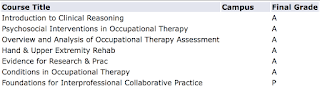 The tests and content covered were also much more difficult. In preparation for the NBCOT exam, the professors have given us 3x more "NBCOT style"questions on tests and quizzes. There were quite a few tests that I felt no bueno about when I handed in my test. Fortunately, in the end, everything turned out well and I was able to pull through with all A's. One of the courses, " Foundations for Interprofessional Collaborative Practice" was combined with "Intro to Clinical Reasoning" and was counted as a Pass/Fail.
This summer, we start our first fieldwork I rounds so I am definitely ready for a change in pace. I will give you more details in my next blog post!
<3 Bemo
Then, there was the fall semester which actually wasn't too bad. The courses themselves and the assignments, tests, projects -- all that, were very manageable. The only thing was my mind wasn't right so my motivation was below sea level. If your mind isn't where it should be the simplest of tasks become difficult.
Finally, there was the spring semester, which challenged me in many many ways. It was uncomfortable, but a much needed experience for both personal and professional growth. I have always understood the importance of being able to work well in a group, but it is something that I have always struggled with. This semester we had crap loads of group projects. I worked well in the groups that were just me and one other person, but the ones with 3 or 4 people to a group were stressful because the dynamics were sometimes off. I'm slowly learning to choose my battles and which projects are okay for me to take a more passive go with the flow role. I wouldn't label myself a perfectionist, but I take pride in quality work. It doesn't have to be perfect, but I like to give my best effort. Another thing that challenged me was "patient" interaction. In my blog post "Looking Beyond Conditions & Physical Interactions," I talked about the awkwardness I felt while interacting with clients at the ADC and how I struggled with feeling inadequate. During this time, I was also going through a "crisis." There were a series of events, that now I am unable to recall, that really challenged me and made me feel incompetent and I had a small break down. It was really bothering me because I have never felt so inadequate in my life and I didn't like how it felt -- very unsettling. As a result, I bought a ton of books with money I didn't really have, in an effort to soothe my discomfort. Three of the books pictured below are actually books required for the summer semester. I will picture them separately in my next blog post when I tell you about my summer semester adventures lol. But anyways, the other 13 books are completely supplementary.
 |
Row by Row; Right to Left:
(1) Stepping Into Handwriting, Creek's Occupational Therapy and Mental Health 6th ed., The Intentional Relationship, Documentation Manual for Occupational Therapy,
(2) Quick Reference Occupational Therapy, Quick Reference Dictionary for Occupational Therapy, Therapeutic Exercise Foundations and Techniques, Assistive Technologies
(3) Critical Reasoning in Occupational Therapy, Optimizing Cognitive Rehabilitation, Activity Analysis Application to Occupation, Physical Agent Modalities
(4) Occupation-Based Activity Analysis, The Successful Occupational Therapy Fieldwork Student, The Wheelchair Evaluation, Spanish for the Occupational Therapist
|
 The tests and content covered were also much more difficult. In preparation for the NBCOT exam, the professors have given us 3x more "NBCOT style"questions on tests and quizzes. There were quite a few tests that I felt no bueno about when I handed in my test. Fortunately, in the end, everything turned out well and I was able to pull through with all A's. One of the courses, " Foundations for Interprofessional Collaborative Practice" was combined with "Intro to Clinical Reasoning" and was counted as a Pass/Fail.
 This summer, we start our first fieldwork I rounds so I am definitely ready for a change in pace. I will give you more details in my next blog post!
<3 Bemo
Thursday, April 23, 2015
2nd Adult Day Center Experience
You will have to bear with me through this post because although it's not late, I'm extremely tired. So, anyways, in a previous post entitled "Looking Beyond Conditions & Physical Interactions" I mentioned that my last experience at the adult day center (ADC) was a hot mess and highly frustrating. I felt very incompetent and my weaknesses were definitely highlighted within the 3 hours that I was there.
I told you guys that if I had time I would let ya'll know how it went this time around. So, my partner and I had 2 "clients" -- the same 2 as last time. Prior to going to the ADC, I texted her and asked which client she wanted to be primarily over. After talking with my professor, I felt that this would be a good idea since I didn't get to participate much in the questioning or interact much with either client. She texted me back her choice and I told her I would take care of the one left. Because I was very anxious about going to the ADC out of fear of messing up or making a fool of myself again, I felt the need to prepare, prepare, prepare. Since this time around we would actually be performing assessments with the clients, I practiced the assessments by recording myself talking to space (my imaginary person). I also took the time to make some reference sheets that I could take with me to help guide my assessments. It was much of the same information in the manual but without all the unnecessary fluff and with a much bigger font size. Here are a few examples of the sheets I made: (you may have to click on the picture to see it better)
 |
| Digit Span Test: Forward Span |
 |
| Cognitive Performance Test: Shopping |
 |
| Cut this paper in half and used it to help guide Activity Card Sort |
 |
| Toggle Category Assessment |
I was so glad that I took the time to make these because it helped my assessments go pretty smooth! The only assessment that I did not make a sheet for was the ACLS-5 (Allen Cognitive Level Screen - 5). My experience at the ADC was MUCH MUCH MUCH better this time around. I also got 2 hugs from two other members of the ADC. Another two people asked me to come sit with them. I told them that I would after I met with one more person (I didn't see a reason not too). Unfortunately, after I finished writing up all my notes, they were heading home :(. Oh well! The lady that I was working with had me write in her notebook what we did with the Activity Card Sort so that she could show her house parents. I'm not even sure if what I wrote many any sense! lol I was focused so much on getting through the assessments that I'm sure it ended up being gibberish. Plus, she made me sign it, so there is no denying that...yup that was me...and yeah I know what I wrote probably made no sense.
Well i'm going to go ahead and get to bed. I'm going to a CEU from 8:30am - 5pm. Obviously I can't get CEU's but I like when going when I can because you get good information!
Ttyl <3
Sunday, April 19, 2015
City of Binders
So in OT school we get A LOOTTTT of papers, handouts, and everything in between. Trying to organize it all has been a CHALLENGE. At first, I thought about just putting all the papers for a semester in a 4 inch binder -- and I did. However, it was heavy and not the easiest to navigate. Plus, our classes often overlap in material, especially when it comes to documentation, interviewing patients, and various conditions. Therefore, organizing by class isn't the best idea either.
 So, instead, I decided that I would buy a crap load of binders and organize them by topic. It has been time consuming since I've had to rummage through my chaos of papers from all my classes pulling things out and putting them together with their mates. However, it's been well worth it. So far I have used 8 of the 13 binders I bought. Pictured to the right is a few examples of some of the binder topics I chose to group together (I have small hands so I could only hold so many lol). I'm still not done organizing everything. I still have a lot of papers to go through and I want to add a table of contents as well as some labeled dividers. When I finish organizing all the papers I haven't gotten thus far in my program I will share the completed "project."
So, instead, I decided that I would buy a crap load of binders and organize them by topic. It has been time consuming since I've had to rummage through my chaos of papers from all my classes pulling things out and putting them together with their mates. However, it's been well worth it. So far I have used 8 of the 13 binders I bought. Pictured to the right is a few examples of some of the binder topics I chose to group together (I have small hands so I could only hold so many lol). I'm still not done organizing everything. I still have a lot of papers to go through and I want to add a table of contents as well as some labeled dividers. When I finish organizing all the papers I haven't gotten thus far in my program I will share the completed "project."
My next biggest challenge will be finding space for all of these binders. On top of all these binders, I also have a ton of OT related books. I have the ones that were required by my program, but I also bought other resources that I thought would be helpful throughout my career (I'll share all of them in a later post). Space won't be as big of an issue when I get my own place, but for now, I must deal with the space I have -- which isn't much.
I'm also sure as the semesters go along I may have to either buy bigger binders, or group them differently, etc. etc. So, that will be interesting as it goes along. My ultimate goal is that all my papers (from May 2014 - May 2016) are well organized by the time Fieldwork II starts (June 2016). If I have all these resources but can't access them quickly then it's really pointless, in my opinion.
Well, that about wraps up this blog post. Just wanted to fill ya'll in on my latest and greatest! lol :)
Friday, April 17, 2015
Looking Beyond Conditions & Physical Interactions
Last year I posted a blog called "Note Taking during Observation & Bridge Burning!" Great blog, in my opinion, but it's missing something - something important. Something I did not realize it was missing until this semester (Spring 2015).
During my observation, I focused soooooo much on the condition the client had, what the therapist did with the client, tips and tricks, all that...but the one thing I forgot to pay attention to was the interpersonal interaction between the client and therapist, the therapist and parents, and the therapist and his/her team. I have over 45 pages of notes outlining my clinical observations and NOT ONE talks about anything of the such UNLESS there was something that the therapist did that I did not agree with.
I did not take the time to note any of the positive, beneficial, or key interactions. Nothing that the therapist said to motivate their client, nothing that the therapist did to support their client when they burst into tears, nothing that the therapist asked to try to understand their patient better, nothing that the therapist did when they could tell their patient was getting hostile, nothing about how the therapist approached his/her colleagues (e.g., other OTs, PTs, nurses, doctors) when he/she had questions, nothing that the therapist expressed when interacting with caregivers...just NOTHING I tell you and that's so unfortunate.
Taking note of the conditions you see and of the specific therapy techniques and activities the therapist does with the client is important, but the interpersonal interactions that occur within the setting is just as important and it's something I failed to attend to during my observation. I won't say I was focusing on all the wrong things, because I wasn't...I actually learned a lot...but what I will say is that the lens I had on was too narrow to see the big picture at the time. And now, as my first year of OT school is coming to a close it is something I regret. But why?, you may ask.
Well, interacting with others on certain levels is not something that comes natural to me and it's a long story as to why. I communicate well with others when it just happens and I'm not putting to much thought into and also when I'm one-on-one with someone. However, lately, I feel like I have to be so much more intentional and when I'm intentional it's just so unnatural, especially if I'm with another person and especially if I have to follow a specific protocol (i.e., that required by an assessment). For example, we have been going to an adult day center to interview some of the members there so we can fill out case maps, do some assessments, and eventually create a treatment plan. When I tell you it's like I couldn't improvise, I couldn't think, I didn't know what to say, it was awkward, and I couldn't play off the dynamics of my group member...I am not joking nor exaggerating. I got so frustrated that day. Plus, the way our seats were positioned was conducive for my group member to interact with the client, but not for me because I was off to the side (not that I wanted to be, it just happened with how my partner sat). Long story short, it was a mess. I think it would have helped if my partner and I would have met prior to discuss how we were going to execute obtaining the information we needed to, but with our schedules so hectic it just wasn't possible. We should be able to meet before we go back again (this coming Thursday) so hopefully my experience will be much better this time around. I talked to my professor about it and she was able to give me some advice so we will see. If I have time, I'll let ya'll know how it goes.
Anyways, back to the point. The point is that I wish I would have took the time to acknowledge how the therapists interacted with others, how they improvised etc. etc. because now I'm faced with situations that are unnatural for me and I have nothing really to go off of but words. Words are great, but I learn best by seeing firsthand. So all-in-all, my advice to anyone who may struggle with interpersonal interactions, are introverted, or just want to see the bigger picture is...don't just focus on conditions and physical interactions, also take notice of how the therapist is interacting with those around them. Hopefully, this will help you not to struggle as much as I have been. I only gave you one example, but I have encountered a handful of situations that were just a big fat mess.
During my observation, I focused soooooo much on the condition the client had, what the therapist did with the client, tips and tricks, all that...but the one thing I forgot to pay attention to was the interpersonal interaction between the client and therapist, the therapist and parents, and the therapist and his/her team. I have over 45 pages of notes outlining my clinical observations and NOT ONE talks about anything of the such UNLESS there was something that the therapist did that I did not agree with.
I did not take the time to note any of the positive, beneficial, or key interactions. Nothing that the therapist said to motivate their client, nothing that the therapist did to support their client when they burst into tears, nothing that the therapist asked to try to understand their patient better, nothing that the therapist did when they could tell their patient was getting hostile, nothing about how the therapist approached his/her colleagues (e.g., other OTs, PTs, nurses, doctors) when he/she had questions, nothing that the therapist expressed when interacting with caregivers...just NOTHING I tell you and that's so unfortunate.
Taking note of the conditions you see and of the specific therapy techniques and activities the therapist does with the client is important, but the interpersonal interactions that occur within the setting is just as important and it's something I failed to attend to during my observation. I won't say I was focusing on all the wrong things, because I wasn't...I actually learned a lot...but what I will say is that the lens I had on was too narrow to see the big picture at the time. And now, as my first year of OT school is coming to a close it is something I regret. But why?, you may ask.
Well, interacting with others on certain levels is not something that comes natural to me and it's a long story as to why. I communicate well with others when it just happens and I'm not putting to much thought into and also when I'm one-on-one with someone. However, lately, I feel like I have to be so much more intentional and when I'm intentional it's just so unnatural, especially if I'm with another person and especially if I have to follow a specific protocol (i.e., that required by an assessment). For example, we have been going to an adult day center to interview some of the members there so we can fill out case maps, do some assessments, and eventually create a treatment plan. When I tell you it's like I couldn't improvise, I couldn't think, I didn't know what to say, it was awkward, and I couldn't play off the dynamics of my group member...I am not joking nor exaggerating. I got so frustrated that day. Plus, the way our seats were positioned was conducive for my group member to interact with the client, but not for me because I was off to the side (not that I wanted to be, it just happened with how my partner sat). Long story short, it was a mess. I think it would have helped if my partner and I would have met prior to discuss how we were going to execute obtaining the information we needed to, but with our schedules so hectic it just wasn't possible. We should be able to meet before we go back again (this coming Thursday) so hopefully my experience will be much better this time around. I talked to my professor about it and she was able to give me some advice so we will see. If I have time, I'll let ya'll know how it goes.
Anyways, back to the point. The point is that I wish I would have took the time to acknowledge how the therapists interacted with others, how they improvised etc. etc. because now I'm faced with situations that are unnatural for me and I have nothing really to go off of but words. Words are great, but I learn best by seeing firsthand. So all-in-all, my advice to anyone who may struggle with interpersonal interactions, are introverted, or just want to see the bigger picture is...don't just focus on conditions and physical interactions, also take notice of how the therapist is interacting with those around them. Hopefully, this will help you not to struggle as much as I have been. I only gave you one example, but I have encountered a handful of situations that were just a big fat mess.
Subscribe to:
Posts (Atom)